|
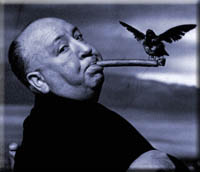
Alfred Hitchcock Director, Producer "If I were to make another picture set in Australia I'd have a policeman hop into the pocket of a kangaroo and yell, Follow that car!." |
|
Lights, Camera, Action
Biography by Aesira Savar
|
Alfred Hitchcock Director, Producer "If I were to make another picture set in Australia I'd have a policeman hop into the pocket of a kangaroo and yell, Follow that car!." |
|
|
Alfred Joseph Hitchcock was born to a Catholic familiy on August, 13,
1899, in Leytonstone, England. His father died when he was fourteen
years old, and Hitchcock had to leave school, although he kept studying
and reading on his own. By that time, he attended theater and cinema
performances regularly, and it was then that Hitchcock discovered his
passion for art and writing.
His filmmaking career began in 1919, when he was offered a position as a title designer for silent films at Paramount's Players-Lasky Studio in London. From there, he learned scripting, editing and art direction, and also developed a great love for the art of filmmaking. Three years later, in 1922, he became assistant director and directed an unfinished film, No.13 or Mrs. Peabody. In 1921, he met Alma Reville, who would become his wife five years later and would had a daugther in 1928. The Pleasure Garden would be his first completed film and was released in 1925, but it wasn't until The Lodger (1926) when Hitchcock revealed his essence and show the genre that would characterize him. His main topics that propelled his fame were murder, suspicion and sexual attraction. His breakthrough film caused different reactions among the public and received both critic and public acclaim. His first sound film was Blackmail (1929), and after that came Murder! in 1930. Both these films showed the director's particular style. A first version of The Man Who Knew Too Much appeared in 1934, and also by that time he had produced 39 Steps (1935), Secret Agent (1936), Sabotage (1936), The Lady Vanishes (1938) and Jamaica Inn (1939), which would be his last British film. All these movies gave him fame and soon became Britain's top film director. Rebecca, his first American movie, which was based on a novel by Daphne du Maurier, won an Academy Award for Best Film in 1940, but it wasn't until The Foreign Correspondent (1940) when the director showed his particular style in Hollywood. Since he was established there, Hitchcock used to produce more than one movie a year. The most successful films were Suspicion (1941), Shadow of a Doubt (1943), Lifeboat (1944), Spellbound (1945), Notorious (1946) and The Rope (1948). During the decade of the Fifties, Hitchcock directed and produced some of his most memorable films, such as Strangers on a Train (1951), I Confess (1953), Dial M for Murder (1954), Rear Window (1954), To Catch a Thief ((1955), a remake of The Man Who Knew Too Much (1956), Vertigo (1958) and North by Northwest (1959). None of these films lacked of ingenious shots, subtle male-female relationships, dramatic score, bright technicolor, inside jokes, witty symbolism and, above all, suspense. Psycho (1960) is known for its classic sequence of the murder in the shower and the great intrigue that keeps the attention of the public, as Hitchcock also achieved with The Birds (1963), Marnie (1964), Torn Courtain (1966), Topaz (1969), the unforgettable Frenzy (1972) and his last film Family Plot (1976). Alfred Hitchcock died from liver failure and heart probems on April 28, 1980. The Master left us, but his work still remains alive. Works Cited and Consulted |