|
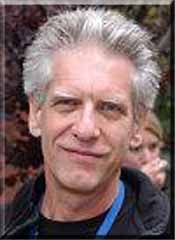
David Cronenberg Director, Producer, Screenwriter, Actor... "Since I see technology as being an extension of the human body, it's inevitable that it should come home to roost."
|
|
Lights, Camera, Action
Biography by Katy
|
David Cronenberg Director, Producer, Screenwriter, Actor... "Since I see technology as being an extension of the human body, it's inevitable that it should come home to roost."
|
|
|
David Cronenberg was born on the 15th March, 1943 in Toronto, Canada. His
mother was a piano player and his father was a freelance journalist.
Cronenberg followed in his father's footsteps at an early age, submitting
science fiction short stories to several local newspapers and journals and
whilst none were ever published he received encouraging responses from their
editors.
Cronenberg enrolled in Toronto University in 1968 as a Science Honours student, however after the first year he became bored and swapped to an English Literature and Language Honours degree. It was during this time that he became interested in filmmaking after seeing a 16mm short film made by a classmate of his. The film piqued his interest and he made two short films of his own, "Transfer" and "From the Drain". These films were highly successful amongst the University's film making community and Cronenberg went on to form the Toronto Film Co-Op with Iain Ewing and Ivan Reitman. He then took a year out to travel around Europe and on returning to University in 1967, graduated first in his class. At this time the Canadian Film Industry was going through massive change. Having been under funded and on the brink of collapse, the Canadian government stepped in and formed the Canadian Film Development Corporation (CDFC).Cronenberg became one of the first directors to receive funding from this scheme for his 1969 film "Crimes of the Future". After this film, Cronenberg decided that if he were to become a successful director he would have to become more "mainstream" in his offerings. During the early 70's, Cronenberg continued his career with a series of short films and also directed for several Canadian television shows. In 1975 he enlisted Ivan Reitman as Producer on another CDFC funded offering, "Shivers". The film received complaints from most of the Canadian political community who questioned whether the government should be seen funding such a film, however that didn't stop "Shivers" becoming one of the fastest recouping films in Canadian Film History. His next film, "Rabid", made in 1978 was again funded by the CDFC with a meager budget of $500,000. The film was an instant hit with filmgoers and critics alike and went on to make $7 million at the box-office. This success was followed up by "The Brood" in 1979, which along with "Shivers" and "Rabid" form a rough trilogy about physical evolution bringing society to a stand still. 1981 saw Cronenberg hit commercial big time, with his box-office smash "Scanners", a story about a telepathic sub-set of society and including the infamous "head exploding" scene. The week it opened "Scanners" was listed by Variety as the Number One movie across North America. His directorial status now firmly in place, Cronenberg moved onto his 1983 Cult Classic "Videodrome" starring James Woods and Debbie Harry, depicting a world where man and technology become fused, with disturbing results. The film was hailed as "The Clockwork Orange of the 1980's" by artist Andy Warhol and enjoyed a resurgence of popularity ten years later in 1993, further adding to its Cult Status. "The Dead Zone" in 1984, starring the superbly chilling Christopher Walken, followed and was again a massive box-office hit worldwide. Based on the best selling novel by Stephen King, it asked the poignant question of if you knew the future, would you change it no matter the cost? The film earned several awards around the globe, including three Avoriaz Film Festival Prizes. After much persuasion, Cronenberg agreed to remake the 1958 Vincent Price classic "The Fly" (1986). The film was a massive success and as well as directing, Cronenberg also starred in an acting role as an Obstetrician. 1988 was a departure for Cronenberg when he moved away from the sci-fi/horror genre and directed a film based on a true life case of two twin doctors who abused their position of trust with patients. "Dead Ringers" was a dark and disturbing tale of one twin's hold over the other and the catastrophic results of what happens when personalities collide. 1991's follow up to "Dead Ringers" was the decidedly less commercial, very disturbing, and frankly weird "Naked Lunch". A "stream-of-consciousness"-esq reworking of a William S. Burroughs novel. This was followed by the more commercially appealing reworking of the stage show Madame Butterfly, "M. Butterfly" in 1993. Probably his most controversial film to date, 1996 saw the release of "Crash" starring James Spader and Rosanna Arquette. The film was banned in Britain for a time, and was only recently awarded a certificate for video retail. The film was deeply disturbing but won critcal acclaim, winning a special Jury Prize at the Cannes film festival. 1999 saw the release of "eXtistenZ" which was Cronenberg's first original script since "Videodrome". It was inspired from an interview Cronenberg did with the author Salman Rushdie, and whilst the film did reasonably well at the box-office, it was not a big hit with the critics. As well as directing for film, Cronenberg has directed two docu-dramas
for CBC's "Scales of Justice" and a rather controversial advert
for "Nike". He has also had small roles in "To Die for"
starring Nicole Kidman, "Jason X" and played the lead in
"Clive Barker's Nightbreed". Never conventional, and always
willing to shock Cronenberg is the master of the modern psychological
horror film.
Submitted: 05.07.03
Works Cited and Consulted |