|
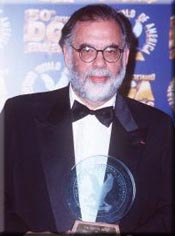
Francis Ford Coppola Director, Screenwriter, Producer "On Monday I was in the theater, and on Tuesday I wanted to be a filmmaker." |
|
Lights, Camera, Action
Biography by Aesira Savar
|
Francis Ford Coppola Director, Screenwriter, Producer "On Monday I was in the theater, and on Tuesday I wanted to be a filmmaker." |
|
|
Having directed great hits but also several failures, Francis Ford
Coppola is one of the most well known directors of the 20th century. He
has won five Academy Awards, several nominations for his films, as well
as two Golden Palms in the Cannes Festival.
The American filmmaker Francis Ford Coppola, was born on the 7th April, 1939, in Detroit, Michigan, USA. Coppola was the son of an American-Italian family who moved to New York after the birth of their second child. Coppola middle name was chosen from The Ford Sunday Evening Hour at CBS, where his father worked. When he was a child, Coppola had an accident that paralysed his left side and had to spend more than nine months in bed. At the beginning, doctors said that he wouldn't recover, but with the help of a physiotheraphist he was able to start walking again. During this long stay in bed, young Francis used to watch a lot TV and did puppet shows to entertain himself. His father was a musician so it was natural that Coppola entered in the world of Art. At an early age he studied music, although he would be a filmmaker years later. When he was completely recovered of his paralysis, Coppola entered the New York Military Academy at Cornwallon-Hudson. By then, he played the tuba and hated the importance that the school gave to sports. Soon, he left that school and, a few months later, he entered high school, where he kept playing the tuba and also started to write his first plays. When he finished his studies there, he achieved a scholarship as a playwright to Hofstra University, where he also became one of the best students and his film studies started there. He graduated in Theater Arts in 1959, then attended UCLA Film School in the sixties where he achieved a Master's Degree. Upon receiving his masters, Coppola began working with director Roger Corman, who was well know for his horror films and scary movies. Coppola helped Corman in his films working as script editor, production assistant, associate producer, dialogue director, sound recorder and second unit-director. In this early period, Coppola also did films of his own like Tonight for Sure (1961), Dementia 13 (1963) and Finian's Rainbow (1968), which gave him his first fame. You're a Big Boy Now (1967) was also of that period as well as it was Coppola's thesis for UCLA Film School. At the beginning of the seventies, Coppola had achieved more fame among the directors and filmmakers. He won an Oscar Academy Award for his screenplay for Patton (1969) and became one of the best directors of the decade. But it was not till 1972, when Coppola released The Godfather, which was directed and co-written by himself, when the American director had very good reviews and critics. Coppola also did two other films during those years: The Conversation, which appeared in 1974, and The Godfather: Part II. If the first film of The Godfather had been a success, its sequel, which was the continued the story of the Corleone family, was a hit and was awarded with seven Academy Awards. Coppola's next hit would be Apocalypse Now, which was released in 1979 and was perphaps the director's most controversial film. Apocalypse Now tells the story of American soldiers during the Vietnam War. At the beginning, the film was supposed to be directed by George Lucas, but finally, it would be Coppola who produced and directed the film. The production of the film carried endless problems, not only of shooting but also weathered financial problems. The film shooting was ended in May of 1977, then came the post production part. In 1979 was completely finished and released and Apocalypse Now was nominated for eight Academy Awards and won two: Best Cinematography and Best Sound. In the same year, at the Cannes Festival, the film achieved the Golden Palm, and during his speech Coppola said: "My movie is not about Vietnam... my movie is Vietnam". But his next work wouldn't be as successful as his previous ones. In 1982, Coppola directed a musical, One From the Heart, with Gene Kelly who starred in (Singin' in the Rain). The entire film was shot and produced on sound stages leaving Coppola to borrow a great amount of money to finance it but only getting half the money back when the musical was released. In 1984, he had another failure: The Cotton Club, which didn't earn a lot of money either. During the eighties Coppola didn't direct any spectacular film, and, apart from these two films, he only directed Peggy Sue Got Married in 1986. The great Coppola returned at the beginning of the nineties and directed The Godfather. Part III (1990). In the same year, and shortly after the last film that closed The Godfather trilogy, Coppola produced and directed Bram Stoker's Dracula, another big hit in the film industry. The sequel to this film was The Revenue from Dracula (1992), which also gave Coppola enough money to solve and forget all the financial problems he had had years ago. After this film, Coppola did Jack (1996) and The Rainmaker (1997), which is the adaptation of the novel of John Grisham. Coppola still has some things to give us as he is in production with a Drama/Sci-fi film called Megalopolis. Works Cited and Consulted |