|
Timothy William Burton Director, Producer and Animator "The great thing about film is that you plan a lot of stuff and then stuff happens." |
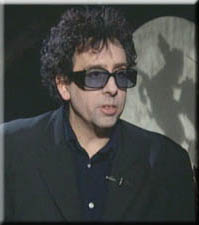
|
Lights, Camera, Action
Biography by Valeera
|
Timothy William Burton Director, Producer and Animator "The great thing about film is that you plan a lot of stuff and then stuff happens." |
|
|
Tim Burton is one of the last people you would imagine would be one of
the most acclaimed directors. He is an introverted, unassuming person.
His career got underway at the most famous animation studio in
Hollywood, landed his first directing gig because of a bootleg tape of
a short film that was never released, and (for a while, at least) had a
movie in the top-ten grossers of all time.
Timothy William Burton was born August 25, 1958 in Burbank, California. Burbank may not ring as many bells as Hollywood, but it is the home to many film and television studios -- NBC, Warner Brothers, Disney, and others. Burbank was quintessential 1950s American suburbia, a world in which the shy, artistic Tim was not quite in lockstep with the shiny happy people surrounding him. He was not particularly good in school, and was not a bookworm. Instead, he found his pleasure in painting, drawing, and movies . . . movies, in particular. He loved monster movies: Godzilla, the Hammer horror films from Great Britain, the work of Ray Harryhausen. One of his childhood heroes was actor Vincent Price. After high school in 1976, Burton attended the California Institute of the Arts. The Cal Arts had been founded by Disney as a "breeding ground" for new animators, though they did offer other courses of study. Burton entered the Disney animation program in his second year, thinking it would be a good way to make a living. In 1979, he was drafted to join the Disney animation ranks. Burton did not enjoy being an animator. Imagine, if you will, what it's like to be an animator. Films are projected at 24 frames per second. For a 90-minute film, that's over 129,000 individual frames. Characters are drawn separately and then put together, and placed over painted backgrounds. The work requires talented artists, but they cannot deviate from the structured manner of drawing the characters. Burton had been brought in to work on The Fox And The Hound. Yes, the director of Beetlejuice was an animator on arguably one of the most saccharine animated features to come out of Disney. It bored him silly. The studio recognized that Burton's talent was not being utilized. They made him a conceptual artist, the people who design the characters that appear in the films. He did early work on The Black Cauldron, the adaptation of the second volume of Lloyd Alexander's Chronicles of Prydain (a seven-volume fantasy series). If you're familiar with Burton's artwork, you can imagine that his concept drawings were nothing like your standard Disney fare. It didn't go over too well, and it was not used. He was set loose on his own projects. These included a poem and artwork that would become The Nightmare Before Christmas, the animated short Vincent, and the live-action short Frankenweenie. The latter two received little or no outside exposure. Frankenweenie was awarded a PG rating, which precluded its release with their G-rated animated features. It only saw theatrical release overseas, and a short release on VHS. It would be the film that would land him his first feature directing job. Horror writer Stephen King (We have heard of that name somewhere.) saw Frankenweenie, and strongly recommended it to Bonni Lee, an executive at Warner Brothers. Lee then showed the film to Paul Reubens. Reubens was the man behind Pee-Wee Herman, and was in the process of bringing his alter ego to the big screen. He knew right away that Tim Burton was the perfect choice for the job, and indeed it was a perfect match. This gave him his first feature film, "Pee-Wee's Big Adventure" for Warner Bros., which he followed with "Beetlejuice." In 1989, Burton directed "Batman," starring Jack Nicholson, Michael Keaton and Kim Basinger. The film successfully reinterpreted and revitalized the mythic superhero for a new generation and became the highest-grossing motion picture in the history of Warner Bros. The National Association of Theatre Owners awarded Burton their Director of the Year Award that year. Burton next directed and produced "Edward Scissorhands" and then returned to Gotham City for "Batman Returns," the highest-grossing film of 1992, which starred Michael Keaton, Danny DeVito and Michelle Pfeiffer in the continuing adventures of the Dark Knight. In 1993, he created and produced the stop-motion animation feature "The Nightmare Before Christmas" which he followed with "Ed Wood." Ed Wood was his critical apex, but his box-office nadir. He was one of the producers of "Batman Forever" and "James and the Giant Peach" which reunited him with the creative team behind "The Nightmare Before Christmas." Between Mars Attacks! and Sleepy Hollow, Tim Burton spent over a year working on a new Superman film. A preliminary script draft was written by independent filmmaker and comic Kevin Smith. Nicolas Cage was attached to the project to play the Man Of Steel. However, Burton was not particularly happy with the script, and a spiraling budget caused Warner Brothers to pull the plug. Alas a project that could have be enjoyable for all the viewing public died a quiet death. His latest project was a remake of the classic Sci-Fi "Planet Of The Apes". A mixed bag of reviews followed Tim's interpretation, but the box office takings were sufficient to ensure that the franchise lives on. We can only await his next project with interest. As for Burton's personal life, he married German artist Lena Gieseke in 1989 (while in the middle of production on Batman). They separated shortly after filming of Batman Returns. He began dating Lisa Marie shortly after, and they are still involved. She has appeared in three of his films to date: Ed Wood, Mars Attacks!, and Sleepy Hollow. His Fanzine is called "Everyone Needs A Hobby" Works Cited and Consulted The Tim Burton Website with a Sense of Humor Filmography: |